By Quim Colomer, Service Director
For many Travel Managers, concierges, and private aviation support teams, ground transportation is often perceived as one of the simplest parts of a journey to organize. A vehicle is booked, pickup details are confirmed, and the operation moves forward. In reality, international premium mobility is far more personalized. Vehicle selection directly affects comfort, efficiency, luggage capacity, access restrictions, passenger perception, and ultimately the success of the overall travel experience.
One of the most common mistakes in global mobility is assuming that a standardized fleet strategy works equally well everywhere. However, what is considered “premium transportation” varies significantly between regions. A large SUV may be the expected executive standard in Miami or Dallas, while in central Paris, Milan, or Tokyo, the same vehicle quickly becomes inefficient. This is due to urban infrastructure, parking limitations, emissions regulations, or cultural expectations around discretion and efficiency.
Vehicle preferences by region
When managing high-profile travelers, these differences matter more than they initially appear. A premium vehicle is only the right choice if it fits the destination, the passenger profile, the luggage requirements, and the context in which the journey takes place.
Latin America and North America
Across Latin America and North America, premium transportation is strongly associated with larger vehicles, particularly SUVs. In cities such as São Paulo, Mexico City, Houston, or Los Angeles, executive transportation is heavily dominated by vehicles such as the Cadillac Escalade, Chevrolet Suburban, Lincoln Navigator, Toyota Land Cruiser, or Toyota Prado.
This preference is not purely aesthetic. In many markets across the Americas, larger vehicles are associated with comfort, security, and robustness. Travelers frequently move with larger luggage volumes, extended-stay baggage, or equipment that requires greater cargo capacity. In Latin America, road conditions and infrastructure variability also influence this preference, making SUVs more versatile than executive sedans in many situations.
For private aviation passengers, SUVs also simplify airport logistics, particularly at large hubs where flexibility, luggage management, and direct curbside access are priorities. In North America, executive travelers often actively expect SUV categories as part of the premium experience.
Group transportation follows a similar logic. Mercedes-Benz Sprinter vans and executive shuttle configurations dominate corporate groups, cruise operations, and large-scale leisure movements because they add scalable capacity to operational flexibility.
Europe and Middle East
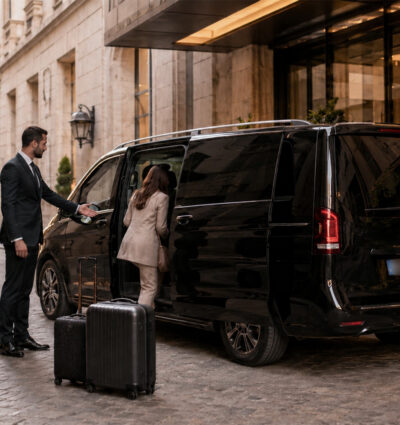
Europe and much of the Middle East operate under a very different mobility model. In most European destinations, oversized SUVs are considerably less dominant than in the Americas. Instead, premium transportation continues to revolve around executive sedans and luxury minivans, particularly the Mercedes-Benz E-Class, S-Class, and V-Class.
The reasons are largely operational. Historic city centers, narrow streets, underground parking restrictions, emissions regulations, and hotel access limitations make large SUVs less practical in destinations such as Rome, Amsterdam, Zurich, or central London. In these environments, efficiency and maneuverability are often valued more highly than vehicle size.
At the same time, European executive travelers frequently associate premium service with discretion, smoothness, and understated luxury rather than visible scale. This explains why the Mercedes-Benz V-Class has become one of the most important vehicle categories in European premium mobility. It provides comfort, ample luggage capacity, easier urban access, and highly efficient airport operations.
The V-Class is also particularly valued within private aviation operations across Europe and the Middle East because it adapts well to FBO environments, executive terminals, and complex city-center logistics while maintaining a premium passenger experience.
Asia-Pacific
Asia-Pacific presents another distinct geography where premium transportation is defined less by size and more by service precision, discretion, and cabin amenities. In markets such as Singapore, Hong Kong, or Seoul, executive sedans including the Lexus LS, Toyota Crown, and Mercedes-Benz S-Class remain dominant. MPVs such as the Toyota Alphard and Toyota Vellfire play a major role in premium group transportation.
Passenger expectations in Asia also differ considerably from Western markets. Travelers frequently place stronger emphasis on chauffeur professionalism and discretion, smooth driving style, cabin quietness, and vehicle cleanliness. Oversized SUVs, which dominate premium transportation in the United States, are far less common in many Asian cities due to urban density, parking constraints, and efficiency considerations.
International travel professionals understand all these cultural and operational nuances. A vehicle category perceived as highly premium in one market may feel completely misaligned in another.
Different traveler profiles require different vehicle strategies
Aside from regional differences, the traveler profile itself also plays a decisive role in vehicle selection:
- Business travelers generally prioritize punctuality, workspace comfort, airport efficiency, and smooth connectivity between meetings, hotels, and airports.
- Families traveling for leisure tend to prioritize luggage capacity, accessibility, and seating flexibility, making SUVs and minivans more operationally effective than sedans in many destinations.
- Cruise passengers introduce additional complexity because they often move with substantial luggage volumes and larger groups, requiring scalable transportation solutions and coordinated dispatching.
- Private aviation travelers, meanwhile, require highly controlled pickup procedures aligned with FBO operations, executive terminal access, and last-minute schedule adjustments.
| Profile | Latin America | North America | Europe and Middle East | Asia-Pacific |
| Business traveler | Mid-size SUV (luggage space) | Full-size SUV | Mercedes E-Class / S-Class sedan | Compact sedan |
| Family on vacation | 7-passenger minivan | 3-row SUV | Mercedes V-Class minivan | Alphard MPV |
| Cruise passengers | 20+ passenger minibus | SUV-based shuttle | Mercedes Sprinter minibus | Compact bus |
| Executive Aviation users | Limousine / black SUV | Escalade / Navigator | Mercedes V-Class minivan | Lexus LS |
In all these scenarios, the difference between “having transportation” and having transportation that actually works operationally becomes very visible. A poorly adapted vehicle category creates delays, passenger dissatisfaction, luggage problems, or unnecessary logistical complexity.
Minibuses are on the rise
One of the fastest-growing areas within premium mobility is executive minibus transportation. As luxury group travel, corporate events, cruise operations, and private aviation support needs continue to grow globally, minibuses are becoming increasingly valuable for many travel professionals.
The challenge is that group transportation often suffers from inconsistent standards. A premium minibus service requires far more than simply allocating a larger vehicle. It depends on proper dispatch coordination, luggage planning, experienced chauffeurs, and fleet consistency.
Vehicle preferences also vary significantly by region. In Europe and North America, Mercedes-Benz Sprinter configurations dominate executive group transportation, while in Asia-Pacific, more compact solutions such as the Toyota Hiace or Hyundai Staria are preferred due to urban density and maneuverability requirements.
This is one reason why online minibus booking solutions are becoming increasingly valuable for premium travel professionals. The ability to centralize larger group transportation with providers capable of maintaining consistent quality standards across multiple destinations reduces uncertainty significantly.

The value of choosing the right partner
Premium transportation is not defined by vehicle categories alone. The real value lies in operational consistency, regional expertise, and the ability to adapt transportation strategies to different passenger profiles and destinations without compromising service quality.
Travel professionals understand that working with transportation partners that understand regional fleet dynamics, local infrastructure limitations, and cultural expectations is what reduces uncertainty and protects the traveler experience.
The best vehicle is not necessarily the largest or most expensive. It is the vehicle that works, both culturally and logistically, for the passenger, the destination, and the journey itself.