
By Jonas Ramirez, Marketing & Communications Lead
As I write these lines, Drivania Chauffeurs is just a few weeks away from celebrating its 25th anniversary. A quarter of a century helping travel professionals arrange ground transportation for senior executives, VIP travelers, and clients looking for something beyond a simple ride.
I joined Drivania in 2006, which means I’ve been fortunate enough to witness most of that journey from the inside. A few days ago, while thinking about several initiatives for the anniversary, I caught up with Rafa, someone I’ve shared much of that journey with.
Rafa has spent many years working as a Travel Advisor for one of the largest telecommunications companies in Spain and Latin America, but our professional relationship goes back much further—to a time when reservations were made with pen and paper, telephones never seemed to stop ringing, and urgent requests had to be handled with far less technology than we have today.
As we talked, we found ourselves doing something that naturally happens when you’ve spent half your life in this industry: remembering stories. Some were significant, others simply amusing, and a few had happened so long ago that certain details had faded with time. Yet every one of them reminded me how much this profession has changed over the past twenty-five years—and, at the same time, how much has remained exactly the same.
After that good conversation with Rafa, I thought it was worth writing down some of those stories and giving them shape so we could share them with our clients, partners, and subscribers. Not simply as an exercise in nostalgia, but as a way to remember how this profession has evolved and everything we have learned along the way.
The night of the flat tire
Just a few days after joining the company, I was working alone on the night shift in Customer Service when I received a phone call I can still remember with remarkable clarity. One of our chauffeurs, who had been assigned to pick up an African diplomatic delegation from a hotel in Madrid and drive them to the airport, had suffered a flat tire and wasn’t going to make it in time.
Today, after many years in the business, I know that a situation like that is best handled calmly and methodically. Back then, I was new, alone in the office, and responsible for a particularly sensitive service. The weight of that responsibility felt enormous.
That night, I woke up more people than I probably should have. I remember calling our fleet coordinator in Madrid, several chauffeurs who had later assignments to see if any of them could take over the service, and even one of Drivania’s founding partners to explain what was happening. In my defense, I simply did what I thought was right: look for alternatives and use every resource available until I found a solution.
Fortunately, everything fell into place and the service went ahead as planned. Still, I was convinced someone would tell me off the next morning for waking half the company in the middle of the night. It never happened. Instead, I learned a lesson that has stayed with me ever since: problems are inevitable, no matter how well you prepare. What earns the trust of both colleagues and clients is how you respond when they appear—and the sense of responsibility you bring to solving them.
The great snowstorm
Anyone living in Barcelona in 2010 probably still remembers March 8, when the city woke up to an almost surreal sight: it was snowing, something that rarely happens in the Catalan capital. As the day went on, the snowfall intensified into a historic storm that brought Barcelona and much of its metropolitan area to a standstill, leaving behind scenes few people had ever imagined seeing in a region known for its mild weather.
While everyone else was trying to figure out how to get home or simply get around the city, our focus at the office was keeping services running. I remember anxious voices on the other end of the phone and the feeling that every decision had to be made on the spot. With public transportation shut down and roads covered in more snow and ice than we’d seen in decades, that day reinforced something I’ve seen time and again over the years: planning certainly helps, but when circumstances become truly exceptional, adaptability is one of the most valuable qualities a service company can have.
Europe versus a volcano
Of all the stories Rafa brought up, one stood out. It took place not long after Barcelona’s snowstorm, during the 2010 eruption of Iceland’s Eyjafjallajökull volcano, when European airspace was closed for several days and one of his company’s executives needed to travel from London back to Madrid. Flying wasn’t an option, so an alternative plan was put together: take the train to Paris and continue the rest of the journey by car.
After many hours on the road, the passenger and the chauffeur decided to stop in Bilbao to get some rest. Once there, they discovered that the city’s airport had partially resumed operations and that flights to Madrid were available again. The executive boarded a plane for the final leg, and what had started as a Paris-to-Madrid transfer ultimately became a Paris-to-Bilbao one. Not bad, considering the circumstances.
Women behind the wheel
Today, seeing women working as professional chauffeurs is completely normal. Twenty-five years ago, it wasn’t. From the company’s early days, we regularly worked with female chauffeurs providing executive and VIP transportation.
Looking back, I remember Nadia in Madrid, Yolanda in Barcelona, Esther in Girona, and Cristina in Milan. Thinking about them now, I realize that, although they were still very much the exception at the time, they were outstanding professionals from the very beginning.
Quite a few passengers were surprised to find a woman behind the wheel. There was never any issue with it; it was simply something many clients weren’t used to seeing. Fortunately, that eventually stopped being remarkable—which is exactly how it should be. Looking back, I’d like to think we were ahead of our time in embracing something that has since become a normal part of the profession.
The London congress
If I had to choose one of the most ambitious projects I remember, it would probably be a major international cardiology congress held in London in September 2015. By then, we had already managed important events, but this was something else entirely. For many weeks, the whole company was involved in one way or another: coordinating hundreds of transfers, managing constant changes, and making sure the right information was available exactly when it was needed.
Part of our team traveled to London to work directly on site and provide operational support to the organizers during the event. I also remember our IT department developing specific software for the occasion, because the complexity of the project required solutions that were not yet available on the market, so we decided to build them ourselves.
When the congress ended and we saw that everything had gone according to plan, we felt we had passed an important test. It was a demonstration of what a team can achieve when everyone is rowing in the same direction.
Lost in translation
Not every story involves an international crisis. Some anecdotes are born from a simple misunderstanding, like the time a client called to request urgent transportation for a “mona” between Barcelona and Lleida.
The colleague who answered the call thought the client was talking about a monkey—mono, in Spanish—and came to me looking completely puzzled. For a few minutes, we tried to figure out what type of vehicle would be most appropriate, what special conditions would be required to transport an animal of that kind, and how we could even begin to organize such a request.
Only then did I realize that the client had actually said “mona,” meaning a traditional Catalan Easter cake. Needless to say, the conversation changed quite a bit from that moment on, and we laughed about that story for a long time.
“Back to the Future”… Sold out
Probably one of my favorite stories from the past 25 years (and one of Rafa’s, too) took place on July 3, 2015. That day marked the 30th anniversary of the release of Back to the Future, Robert Zemeckis’s iconic film, and the occasion received plenty of media attention around the world.
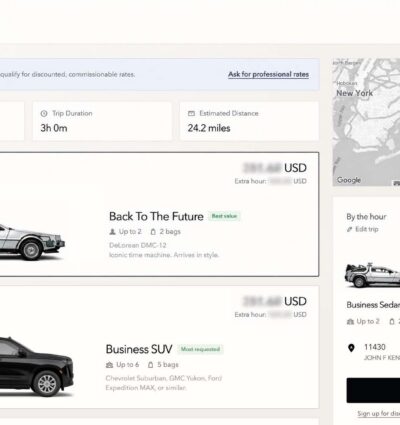
I can’t remember exactly whose idea it was, but someone came up with the brilliant notion of adding a DeLorean to our online booking system. Yes, the DeLorean from Back to the Future. It was nothing more than a playful Easter egg for anyone who happened to spot it while browsing the platform. What none of us expected was that people would actually try to book it.
The funniest part wasn’t that someone wanted to reserve a fictional time machine. It was that a few clients called and emailed us because the DeLorean showed up as unavailable, and they wanted to offer it to passengers they knew were fans of the movie.
To this day, I can’t think of a better example of the company’s sense of humor than watching our team respond with complete professionalism to requests involving a fictional car. A time machine, no less.
When the world stood still
Then came the pandemic. Over the years, we had learned to deal with snowstorms, airline strikes, flight cancellations, every kind of operational disruption imaginable, and large-scale international events. But nothing had prepared us for seeing global mobility come almost to a complete standstill overnight.
I still remember those first days with remarkable clarity: reservations disappearing by the hundreds, empty airports, clients trying to understand what their options were, chauffeurs wondering when they would be back on the road, and a level of uncertainty I had never experienced before. Even so, the work never truly stopped. It simply changed. The volume was different, the rules were different, and almost every day brought a new challenge to solve.
It’s always easy to make sense of events in hindsight, and I would rather not pretend we had all the answers. But looking back, I do think the pandemic reminded us of something essential: technology matters, processes matter, and experience matters—but when circumstances change overnight, people are still what make the difference.
What has never changed
Over these twenty-five years, vehicles have changed, technology has changed, the way we communicate has changed, and our clients’ expectations have changed as well. We have lived through historic snowstorms, volcanic eruptions, international congresses, amusing misunderstandings, harmless practical jokes that went further than expected, and a global pandemic.
Yet one thing has remained exactly the same from the very beginning: behind every reservation, there is always someone who needs to get somewhere, and behind every challenge, there is always someone waiting for a solution.
Maybe that is why, when I look back, I do not remember the cars as much as I remember the stories. After twenty-five years, I still believe those stories are what best explain this profession.
Happy 25th anniversary, Drivania.