By Quim Colomer, Service Director
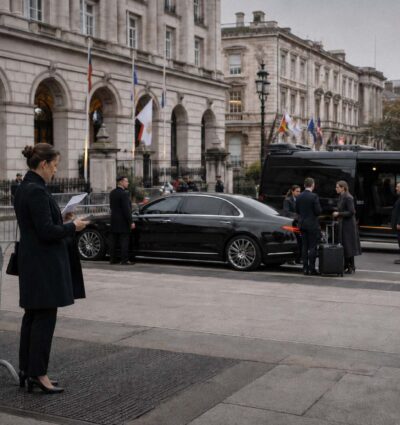
When a Head of State arrives in a city, the most visible aspect is ceremony. People see motorcades, flags, security escorts, official receptions, and carefully choreographed public appearances. Regardless of its purpose—whether it is a presidential state visit, a royal tour, or a papal journey—the public experience is designed to look controlled. What remains invisible is the level of coordination required to make those moments possible.
For travel and corporate mobility professionals, an official visit creates a very specific reality. Roads close without warning, security perimeters expand and contract throughout the day, hotels change their access protocols, airport operations are affected, and entire sections of a city are placed under temporary restrictions.
During a state visit, knowing the usual city map is not enough. The public sees the principal guest, but the Travel Manager is responsible for everyone else.
A state visit is never about one person
One of the most common misconceptions surrounding official visits is that they revolve around a single individual. In reality, every state visit consists of several independent movement groups operating simultaneously, each with different objectives, schedules, security requirements, and transportation needs:
- At the center sits the VVVIP core: the Head of State, monarch, Pope, or senior dignitary together with their closest advisors, protocol officers, and immediate support staff. They typically travel in official vehicles provided by the host country or government, always in coordination with the visiting delegation’s own protocol team.
- Alongside them travels the official delegation, often composed of government representatives, diplomats, advisors, and senior civil servants participating in bilateral meetings and official engagements. In most cases, their travel arrangements are also managed by the Protocol Department or a similar body.
- A third layer consists of the business delegation. These are the CEOs, chairpersons, investors, industry leaders, and senior executives who travel to participate in business forums, trade missions, investment meetings, and networking opportunities associated with the visit. For this group, travel departments or specialized agencies are usually responsible for logistics.
- Together with all of these groups are the supporting teams, which include security teams, advance teams, communications personnel, media organizations, and technical staff responsible for ensuring the proper execution of the program. These teams may also require private transportation, although it is not always guaranteed through protocol channels.
The business delegation moves outside the protocol structure
Each group moves differently. The Head of State follows a protocol-managed schedule supported by official transportation resources. The business delegation does not, and moving this group becomes considerably more complicated.
From a mobility perspective, the business delegation is often the most demanding group to manage. Its members are working within the same security environment as the official delegation, facing the same road closures, access restrictions, airport disruptions, and timing pressures. However, they do not travel within the protected structure of the official convoy.
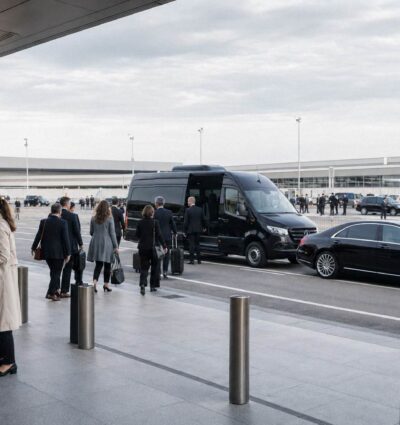
They still need to move between airports, hotels, and venues. During a typical state visit accompanied by a trade mission, the Head of State follows a tightly controlled protocol schedule, while CEOs, investors, and corporate representatives attend parallel meetings across multiple locations throughout the city. Their transportation requirements are no less important, yet they must operate without access to official convoys, police escorts, or protocol vehicles.
In many cases, their agendas are less predictable than those of the official delegation. It’s not unusual for a meeting to be added at the last minute or extended beyond its scheduled end time, or for a venue to change. For these travelers, mobility is directly connected to business outcomes. Missed timing windows can mean missed meetings, which in turn can mean missed opportunities.
State visits create a unique mobility environment
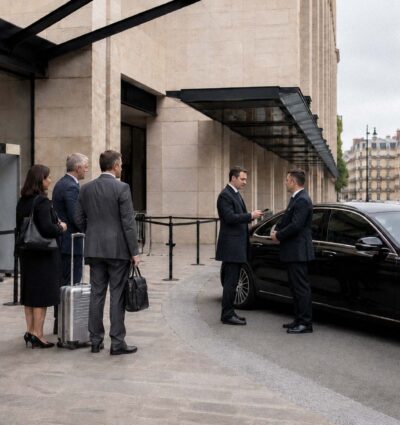
Security planning often begins weeks before the principal delegation arrives, but many logistical decisions remain open until the day of the visit. Hotels add screening procedures, access points are relocated, streets close temporarily to accommodate official movements, and airport operations are adjusted to support government aircraft and security protocols.
For a Travel Manager, the challenge is that these changes do not affect only the official delegation. They also impact executives, sponsors, advisors, media teams, and invited guests moving around the same city on parallel schedules. A route that was available in the morning may no longer be available in the afternoon; an entrance used for one event may be restricted before the next; and travel times can change significantly without any corresponding change in distance. As a result, predictability matters more than speed.
What premium chauffeur services solve
Most transport providers can complete a VIP transfer. Supporting a delegation during a state visit is a different discipline. The vehicle matters, but the real value lies in maintaining control: knowing where the passenger needs to be, which access point is still valid, what has changed since the last movement, and who needs to be informed before the next transfer takes place.
A premium chauffeur service gives Travel Managers continuity throughout a day when the schedule can change several times before it ends. Airport arrivals, hotel departures, meeting venues, official receptions, private dinners, and last-minute schedule changes are not isolated transfers. They are connected movements. If one is delayed or poorly coordinated, the rest of the day is affected.
For business delegations, vehicle selection also becomes a practical risk-control decision. Senior executives often travel with advisors, assistants, security personnel, or colleagues, which means that a sedan is not always the right answer. Business minivans and minibuses can allow small groups to remain together, protect privacy, and reduce the number of vehicles that need to be coordinated inside a restricted environment.
During a state visit, knowing the city is not enough. The chauffeur and coordination team need to understand how the city behaves under restrictions: which hotel entrances remain usable, which routes are likely to be affected by official movements, where delays tend to accumulate, and which arrival windows offer the best chance of a controlled transfer.
The value of the service lies in reducing the number of decisions the Travel Manager has to make while the visit is already in motion.
Preparing for a State Visit
Travel Managers supporting senior executives or business travelers during an official visit should start preparing well before the delegation lands. The priority is to understand that the traveler may not be part of the official convoy but will still be affected by the same restrictions.
Several points deserve particular attention:
- Begin transportation planning as soon as the main accommodation, venues, and airport movements are confirmed.
- Treat the business delegation as a separate mobility layer, not as an extension of the official delegation.
- Build additional time into airport arrivals, hotel access, and venue entry during periods of heightened security.
- Confirm vehicle capacity based on passengers, accompanying staff, luggage, security personnel, and working materials.
- Establish one clear coordination channel between the traveler, chauffeur, travel team, and any supporting agency.
- Prepare alternative routes and access points, especially for hotels, government buildings, conference venues, and private dinners.
- Work with transport providers that understand high-profile movements, not only conventional point-to-point transfers.
The strongest plans are rarely the most complicated. They are the ones that identify the main points of exposure early enough to prevent them from becoming live issues.
The measure of success
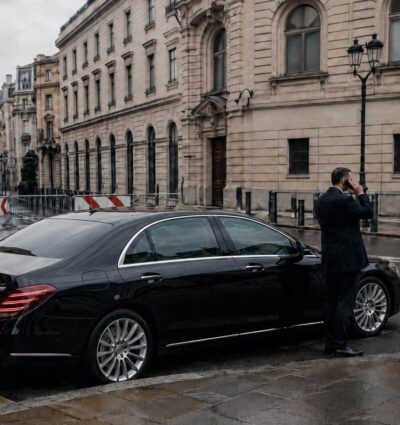
Official visits are usually remembered through images: motorcades, ceremonies, state dinners, handshakes, and headlines. For the people responsible for moving senior travelers around the city, success looks much less visible.
In practice, good coordination means that the executive reaches the meeting without feeling rushed, the delegation stays together when it needs to, and a last-minute venue change does not require the whole day to be rebuilt. It also means the Travel Manager is not forced to spend the afternoon chasing updates from different providers, while the traveler remains focused on the meeting rather than on how to get there.
A state visit should never be planned as a standard travel program. The schedule can be affected from several directions at once: airport procedures, hotel access, venue security, city-center restrictions, or a route that changes between one part of the itinerary and the next.
The farther a traveler is from official protocol transport, the more important professional mobility coordination becomes. Excellence is not measured by who sits closest to the Head of State, but rather by who arrives with time to spare, ready for the next meeting, and able to use the journey productively.