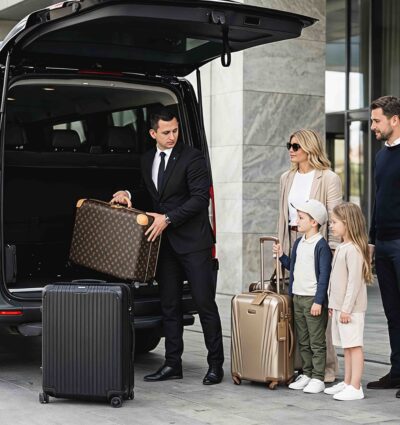
There is one aspect of premium travel that is often underestimated until it causes a problem: luggage. For a Travel Manager, Executive Assistant, or Concierge, the risk lies in making decisions with incomplete information. While the number of passengers is usually clear from the start, the actual volume of luggage isn’t always clear.
If, at the time of pickup—with the vehicle already in position and the client ready to depart—the luggage does not fit in the trunk, an issue arises that directly impacts the passenger’s experience and highlights a lack of control over the service.
Why luggage remains a blind spot
In high-pressure environments, planning tends to be simplified out of necessity. Speed in booking is prioritized, and a reasonable standard for luggage is assumed. However, in practice, that standard is not always met.
In private aviation, for example, passengers often travel with more bags than anticipated, especially for international flights or extended stays. On business trips, while executives tend to travel with few or no suitcases, the volume of luggage can increase significantly during financial roadshows or multi-day itineraries. And especially on vacation trips, it rarely follows a predictable pattern.
There is another factor to consider: the passenger is not always the one providing the information. The Travel Manager works with various intermediaries (assistants, agencies, or brokers), and the details may arrive incomplete or late. As a result, decisions that might seem correct at the outset no longer hold up in practice.
Luggage volume as a decision-making framework
The most effective way to eliminate this risk is to adjust how decisions are made. Changing the question from “How many passengers are traveling?” to “What is the volume of luggage being transported?” allows us to anticipate situations that would otherwise only be detected when it is too late.
A common scenario is three passengers traveling comfortably and with plenty of space in a premium sedan; however, if they are carrying six large suitcases, the assigned vehicle is no longer the right choice. The problem is not the car but how it was selected.
In practice, many errors arise from an inaccurate perception of vehicle capacity, as not all executive-class models offer the same amount of space. As an operational reference, the following values can be considered:
- A business- or premium-class sedan (e.g., Mercedes E-Class or S-Class) is the right choice for traveling with two large suitcases and two carry-on bags. The difference between the two lies not so much in capacity as in the level of comfort.
- A large SUV (e.g., Cadillac Escalade or GMC Yukon) provides additional space, typically for three to four large suitcases, without compromising cabin space.
- An executive minivan (e.g., Mercedes V-Class) can handle a larger load, with configurations that can accommodate between six and eight large suitcases, depending on passenger occupancy and seat arrangement.
In any case, these figures should not be interpreted as theoretical maximums but rather as practical guidelines that provide some flexibility.


Maximum capacity vs. operational capacity
One of the most common mistakes is planning luggage to the very limit of the vehicle’s capacity. Technically, a vehicle can accommodate more luggage than recommended, but that doesn’t mean it’s the best decision. When capacity is pushed to the limit, situations arise that directly impact service:
- Longer loading times at the airport or FBO.
- Reorganizing luggage in the passenger’s presence.
- A feeling of overcrowding that impacts the overall perception of the service.
In time-sensitive situations where efficiency is a priority, extreme optimization is often counterproductive. Building in some buffer reduces risk and improves execution.
When luggage volume is high and the goal is to maintain a certain vehicle standard for passengers, there is an operational solution that is not always considered: separating passengers and luggage.
For example, assigning a premium sedan for passengers and a support minivan exclusively for luggage. This approach also allows passengers to travel ahead in the main vehicle during an airport transfer, while the chauffeur of the support vehicle remains at the pickup location organizing the luggage and rejoining the service later.
This approach is particularly useful in scenarios such as:
- Passengers who prioritize discretion or traveling in a specific type of vehicle.
- Transfers for private aviation with bulky luggage.
- Trips where the luggage clearly exceeds the capacity of any standard configuration.
Anticipating needs based on the trip
There are situations where good planning before the start of service makes all the difference. In private aviation, where the transition between air and ground is very brief, any adjustments at the time of pickup have an immediate impact. Confirming luggage requirements before arrival and allocating space with a buffer avoids relying on reactive solutions.
On roadshows or itineraries with intense schedules, luggage is not static. Work materials, documentation, or even purchases accumulate throughout the day. Anticipating additional capacity from the start prevents the need to reorganize luggage or even switch vehicles midway through the day.
For long stays, the most common mistake is to project the luggage from the first day onto the rest of the trip. Building in extra capacity at the start reduces the need for later adjustments.

Visibility and responsiveness
When a Travel Manager books a chauffeur-driven vehicle for their clients, they need to have the right information. There are four key elements for making an informed decision:
- Number of large suitcases.
- Carry-on luggage.
- Special items (golf clubs, skis, musical instruments, shopping).
- Possible changes during the trip.
It is important to keep in mind that, even with validated information, changes can occur: additional luggage, changes in the number of passengers, or adjustments to the itinerary. Detecting these in time and managing them correctly is key to avoiding issues.
A solid operational approach includes a pre-service review before pickup and the early detection of inconsistencies. This way, any contingency is managed before it becomes a visible problem for the passenger.
Smart luggage management
Luggage is not just a logistical detail; it is a variable that affects the entire execution of the service. When managed reactively, it can negatively impact the passenger experience. When integrated into planning from the very beginning, it stops being an issue and allows for greater predictability, reduced incidents, and maintained control throughout the service.
A ground transportation provider must have the right fleet, but also the ability to anticipate risks and propose the optimal configuration in each case, ensuring that, even if an unforeseen issue related to luggage arises, the passenger never notices it.