By Frank Davidson, Business Aviation Specialist
In business aviation, the time an aircraft lands and the time passengers or crew reach their vehicles are two different points in the operation. Taxi time, the position assigned on the ramp, FBO procedures, and access restrictions determine how much time separates the two.
Passengers and crew follow different timelines after landing. The former usually leave shortly after reaching the FBO, while the latter remain with the aircraft to complete post-flight duties. Separate vehicles arranged for the same arrival, therefore, do not necessarily need to be ready to depart at the same time.
Landing time is not pickup time
Wheels down is only one reference point for an arrival transfer. The aircraft still has to taxi to its parking position, and ramp conditions can affect the time passengers take to reach the FBO. NBAA notes that long taxi distances and congestion on an FBO ramp can prolong ground operations.
For the crew, the gap is usually longer. Taxiing, parking, and shutting down the aircraft, together with the post-flight procedures that follow, mean the crew vehicle often departs later than the passenger vehicle. In Drivania’s experience, it is not unusual for the two departures to be 45 to 60 minutes apart.
And a basic distinction is still worth keeping in mind before departure: a hotel pickup for an outbound crew needs to be calculated from the time the crew is required at the FBO and aircraft, rather than from the aircraft’s scheduled departure time.
The FBO changes how the pickup works
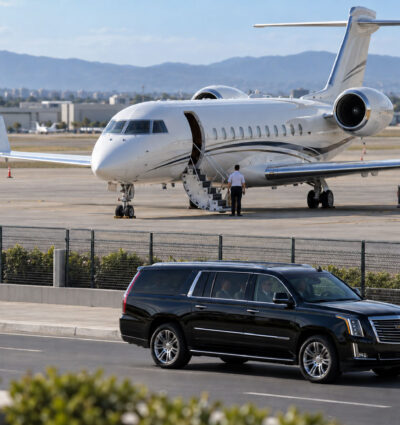
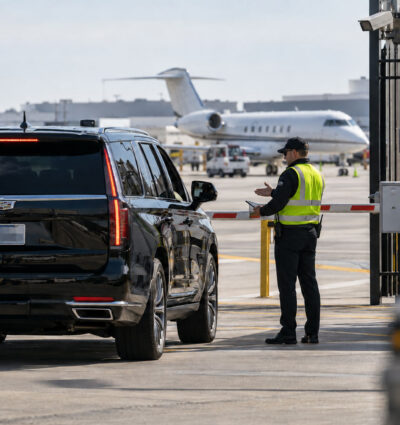
Planeside pickup does not work the same way at every FBO. Some locations allow an authorized vehicle to approach the aircraft under specific conditions, while others require passengers and crew to move through the FBO before meeting the chauffeur. Prior approval and FBO escort may also be required for passenger vehicles accessing the ramp.
A request for planeside pickup still needs to be matched to the procedure at that location. The authorization process, vehicle entry point, and movement inside the restricted area all need to be clear before arrival.
The same procedure should not be assumed at the next airport or FBO. Even when the passenger or crew movement looks identical, vehicle access and handover arrangements can change from one location to another.
The information required before pickup
Aircraft registration or flight number is only part of the information needed for the ground transfer. At airports with multiple handlers or facilities, the FBO also needs to be clearly identified, particularly when the available facilities are located in different parts of the airfield.
The booking should also distinguish clearly between passenger and crew movements. They will leave at different times, use different vehicles, and continue to different destinations even when both transfers originate from the same aircraft.
Changes require a clear communication path as well. If the aircraft switches FBOs, the parking position affects the handover, or passenger and crew movements change after arrival, the chauffeur needs an update from the person coordinating the transfer.
Vehicle identification becomes more important when security requirements are higher. Sharing the chauffeur’s name, vehicle details, and contact procedure in advance helps remove ambiguity at pickup without circulating more passenger or itinerary information than necessary.
Special luggage, pets, and other requirements
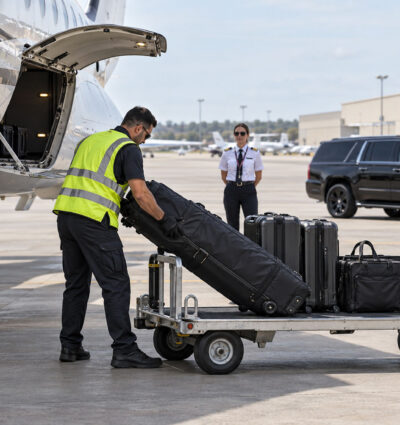
Passenger count does not always describe what needs to move from the aircraft. Crew bags, flight equipment, sports gear, or delicate items can require more space or a different handling procedure than standard passenger luggage.
Baggage protocols can also affect the handover. Some flight departments maintain line of sight with baggage until it reaches the aircraft, rather than leaving it unattended with third parties. Where that kind of protocol applies, the movement between aircraft, FBO, and vehicle needs to preserve it.
Pets introduce a different set of practical requirements. The number and size of animals, carriers, passenger count, and luggage must be known before dispatch so the appropriate vehicle can be assigned. Flight, customs, and veterinary requirements remain separate from the ground transportation operation.
Some items require additional coordination beyond their size or handling needs. Firearms carried for hunting trips are one example. In the United States, federal rules for interstate firearm transportation include specific requirements for how firearms and ammunition are carried in a vehicle, while state and local laws may impose additional conditions. Requirements should therefore be checked for the ground journey as well as the flight.

Security at the handover
Ground transportation security starts with a clearly identified pickup. The relevant parties need to know who is driving, which vehicle has been assigned, where the handover will take place, and how any last-minute change will be communicated.
This is particularly important in business aviation because the ground transportation provider may have access to sensitive operational information, including traveler identities, aircraft movements, hotel details, and timings. Vetting therefore applies not only to the chauffeur and vehicle, but also to how that information is handled.
The amount of information shared should still be limited to what each party needs for the transfer. A chauffeur may need passenger names, pickup instructions, and an operational contact without requiring visibility over the complete itinerary or other movements unrelated to the service.
Security requirements also vary by destination and traveler profile. The ground transfer should follow the operator’s own procedures rather than introducing a separate process that conflicts with existing security arrangements.
By the time the aircraft reaches the ramp, most of the ground transfer should already be defined. Pickup location, vehicle access, passenger and crew movements, and any special requirements are much easier to resolve before arrival than once everyone is already on the ground.