
By Jonás Ramírez, Marketing & Communications Lead
There is something about September that feels remarkably similar to January. Calendars fill again, postponed conversations return to the agenda, offices regain their usual pace, and projects that seemed comfortably distant in June suddenly have deadlines attached to them. The difference is that September does not offer the luxury of a full year ahead. Companies return from the summer with Q4 already approaching and a relatively short window in which to complete plans, close business, and prepare for the following year.
That change is particularly visible in corporate travel. Board meetings resume, client visits multiply, conferences return to the calendar, and senior executives begin moving again between the cities where decisions need to be made. For Travel Managers and Executive Assistants, the return to business rarely happens gradually. A calendar that looked manageable at the end of August can become considerably more demanding within a matter of days.
The numbers point in the same direction. Business travel spending accelerated by 8% during the second quarter of 2026, while travel across corporate networks increased by 10%, the strongest growth seen in several quarters. Looking ahead, corporate travel budgets are expected to increase by a further 5% globally in 2026, with higher airline passenger volumes and hotel demand forecast throughout the year. Those figures help explain why September places such pressure on the people responsible for organizing executive travel.
Preparing before the return
Although September often feels like a fresh start, very little actually begins from scratch. Board meetings have already been scheduled, annual conferences have fixed dates, product launches are approaching, and sales teams are entering the final quarter with targets still to achieve, while executive calendars begin to fill again after weeks of lighter activity.
For the people coordinating business travel, September is less about starting again than making sure everything is ready for the busier months ahead: preferred suppliers need to be ready, traveler preferences refreshed, recurring itineraries confirmed, and complex trips coordinated before diaries become difficult to manage again.
By the time the first executive boards a flight after the holidays, much of the work has already been done behind the scenes.
The diary fills faster than expected
September calendars rarely leave much room for adjustment. Flights that were easy to book a few weeks earlier fill quickly, preferred hotels tighten availability, and restaurants around financial districts and conference venues return to full business demand.
Executive itineraries also become tighter. An arrival from the airport may lead directly to the office, followed by a client lunch, an afternoon meeting, and dinner before an early departure the next morning. Once the day is built that tightly, even small changes begin to matter.
A delayed flight can remove the planned stop at the hotel. A meeting that overruns may leave less time to cross the city, while an evening event can finish late without changing the first commitment of the following morning. These are normal features of executive travel, but September tends to bring more of them together at the same time.
By the second week of September, many travel teams are no longer preparing for the return to business—they are already responding to it. Executive diaries overlap again, several travelers may be moving at the same time, and changes that would have been manageable in August now compete for attention with a much busier schedule. Small inaccuracies that went unnoticed before the holidays suddenly require attention.
That is why early September is often the right moment to confirm traveler profiles, preferred arrangements, airport procedures, and recurring itineraries before the pace accelerates further.


When several appointments become one journey
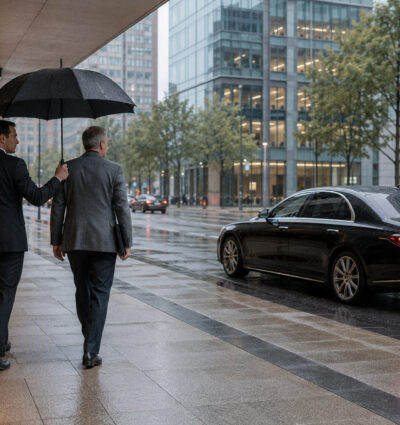
Treating each part of a journey separately creates more decisions, more confirmations, and more opportunities for information to become fragmented. For tightly scheduled days, keeping the same chauffeur throughout the day is often more effective. A driver who already understands the day’s itinerary can adjust when the first meeting runs longer, remain available when an address changes, and coordinate the following movement without requiring the traveler or Executive Assistant to arrange another vehicle from scratch.
Flight monitoring keeps the day’s schedule aligned, allowing the ground schedule to adapt if an aircraft arrives early or late. Vehicle selection is equally important when executives travel with colleagues, assistants, security personnel or significant luggage between multiple appointments. The value of this approach lies in reducing the number of logistical decisions that need to be made during a day already filled with business decisions.
September is a useful time to test the travel setup
The beginning of the autumn business season also gives Travel Managers an opportunity to look critically at the arrangements supporting their most frequent travelers.
- Are airport pickups easy for passengers to understand?
- Are chauffeur details communicated with enough time in advance?
- Can changes be made without involving several suppliers?
- Is there support available when an evening event ends later than planned?
- Can the same service standards be maintained across different cities?
These questions become more relevant as corporate travel grows. Recent industry research shows that 90% of business travelers now regard business travel as an essential investment rather than a discretionary expense. At the same time, Travel Managers remain under pressure to control costs, making September a particularly good moment to distinguish between savings that strengthen a travel program and those that simply transfer additional work or uncertainty to the people managing it.
The cheapest individual transfer may look efficient on a spreadsheet. It becomes less efficient when an Executive Assistant spends twenty minutes finding the chauffeur, reorganizing a missed pickup, or explaining an itinerary change to separate providers.
A second beginning, with less time to spare
Perhaps September feels like a new year because so much begins again at once. Meetings return, airports fill with business travelers, conferences restart, and companies turn their attention toward the results they still need to deliver before December.
For those in charge of corporate travel, there is an advantage in recognizing that routine before it arrives. Reviewing upcoming travel, identifying the busiest executives, confirming preferences, and organizing transportation around complete itineraries rather than isolated movements can remove a surprising amount of friction from the months ahead. The summer may be over, but the year is far from finished. In many companies, September is when its most decisive part begins.