
By Quim Colomer, Service Director
Managing a group starts to become more complicated as soon as several vehicles are involved. Even a relatively simple airport pickup may require decisions about which passengers travel together, how luggage is distributed, whether security needs to remain with a particular traveler, and whether everyone should leave and arrive at the same time.
Those details matter because a change affecting one vehicle can quickly affect the others. If an executive is delayed at the terminal, for example, the coordinator may need to decide whether the rest of the delegation leaves without them, whether security stays behind, or whether the original vehicle assignments still make sense.
Travel Organizers have to keep several moving parts aligned at once: passenger assignments, timing, security requirements, and individual needs. As the itinerary changes, so do those elements.
Not every vehicle needs to move together
Multiple vehicles do not always need to leave together or arrive at exactly the same time. The right approach depends on how the group is meant to move.
Some passengers may need to reach a meeting within the same arrival window even if they leave from different locations, while other vehicles may be carrying luggage, staff, or security on a separate schedule.
The important part is knowing which movements depend on one another. A delay to one vehicle may have little impact if the journeys are independent, but it becomes more significant when that vehicle carries the principal, security personnel, or luggage needed by the rest of the group.
Vehicle assignments and naming
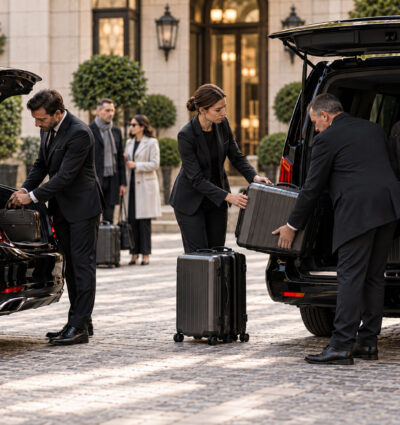
When several similar vehicles are waiting at the same location, passenger assignments cannot be left until pickup. Each vehicle needs a clear reference and an assigned group before the travelers arrive, particularly when luggage, assistants, or security are moving with them.
A simple naming or numbering system gives chauffeurs and coordinators the same point of reference throughout the service. Neutral identifiers such as “Vehicle 1” and “Vehicle 2” or “Vehicle A” and “Vehicle B” can also avoid unnecessarily displaying passenger names when discretion applies.
Assignments can change during the day, but the update needs to go beyond moving a name from one vehicle to another. A reassignment may also change where luggage is carried, which chauffeur is responsible for the next pickup, or how security remains positioned around the group.


Transport requirements by group type
The way multiple vehicles are organized depends largely on the group, its schedule, and the people traveling.
- Corporate delegations: Meetings and individual agendas usually determine how the vehicles are organized. Several executives may travel together from the airport and separate later for different appointments, while assistants or security personnel follow specific members of the delegation. Return journeys can also take place at different times, particularly when some travelers leave directly for the airport after a meeting.
- Organized groups: Participants may not all follow the same schedule or use the same vehicles. Some travel with staff, equipment, technical material, or other items that require additional space, while others may split into smaller subgroups during the day. Fixed arrival times, rehearsals, performances, matches, official visits, or scheduled activities can create several transport windows within the same itinerary.
- Private families: Arrivals may involve family members, children, nannies, assistants, security, and considerable luggage. Once at the destination, the group can split into different agendas, with separate vehicles needed for activities, restaurants, appointments, or individual family members. Child seats, luggage distribution, and accompanying staff also influence the vehicle assignments.
Managing sensitive information
Discretion in group travel depends partly on how widely information is shared. Not every chauffeur or coordinator needs access to the full itinerary, particularly when the group includes high-profile executives, VVIP travelers, or private families.
The information provided should match the role each person has in the operation. A chauffeur may need the passenger assignment, pickup details, destination, and an operational contact, but not necessarily the principal’s complete schedule or the movements of other vehicles.
Changes during the day should reach the people affected without unnecessarily widening access to the rest of the itinerary. Passenger identities, destinations, conversations, and travel patterns should also be treated as confidential, with no photographs or social media activity related to the service.
Changes and contingencies
An executive staying longer at a meeting, a delayed flight, or a family member returning to the hotel earlier than planned usually impacts vehicle availability and passenger assignments later in the day.
Clear responsibilities make those changes easier to manage. The Travel Organizer needs a clear point of contact, while chauffeurs need to know where updated instructions will come from and which parts of the itinerary are affected. If security is involved, changes to passengers, vehicles, or departure times may also need to be coordinated with the security team.
Vehicle availability is another consideration, particularly when the schedule is tight. A vehicle delayed on one service may already be assigned to another passenger later in the day. Keeping some flexibility in the original plan makes it easier to accommodate changes without having to reorganize the entire group.
Multi-vehicle coordination
The transport plan needs to remain visible as a whole, even when individual vehicles are operating independently. Travel Organizers need to know where each vehicle is expected to be, who is traveling in it, and how a change in one part of the schedule affects what comes next.
Effective coordination depends on maintaining an up-to-date view of vehicle assignments, passenger movements, and schedule changes throughout the service.