By Joshua Biondi, Business Expansion Manager
Every autumn, the financial industry begins a journey that is remarkably consistent from one year to the next. As soon as the summer holidays come to an end, thousands of senior executives, investors, regulators, consultants, and fintech leaders start traveling between a handful of cities that, for a few weeks, become the meeting point of global finance.
For Travel Managers and Executive Assistants, those weeks represent far more than a succession of conferences. They involve supporting journeys where schedules evolve constantly, meetings are added with little notice, and each part of the journey has an impact on what follows. During this period, the conference itself often becomes just one appointment among many.
Four conferences, one business season
The season begins in early September with the Handelsblatt Banking Summit in Frankfurt, followed a few days later by FinovateFall in New York. By the end of the month, Sibos opens its doors in Miami before Money20/20 USA brings the season to a close in Las Vegas in October. Although each event has its own identity, together they form a business calendar that many financial institutions approach as a single period of continuous activity rather than four separate conferences.
That continuity is easy to overlook because conference programs naturally attract most of the attention. Yet they rarely explain the full reason why people have traveled in the first place.
The conference is only part of the agenda
For many finance executives, the official program serves primarily as the framework around which the real schedule is built. The conference may provide the setting for important discussions, but it is rarely where they all begin or end.
Client breakfasts, investor meetings, private lunches, strategy sessions, and evening dinners are often arranged weeks before the event begins because conferences provide something increasingly difficult to recreate elsewhere: the opportunity to bring together people who spend most of the year working in different countries and time zones. As a result, much of the day is spent moving between hotels, corporate offices, restaurants, private meeting rooms, and networking events across the city rather than remaining inside the conference venue.
From the outside, it looks like an exceptionally busy business trip. In reality, it is a tightly scheduled sequence of meetings where each one depends on the previous one finishing on time.
That changes the role of travel planning considerably. Success is no longer measured simply by arriving before the first keynote. It depends on whether an itinerary involving fifteen or twenty appointments over two or three days can unfold naturally without forcing executives to spend their time managing logistics instead of focusing on the people they have traveled to meet.
When every minute already belongs to someone
By the time an executive lands, most of the following two or three days are already spoken for. The agenda leaves little room for delays, changes of plan, or journeys that take longer than expected.
Arriving ten minutes late to a breakfast meeting may reduce the time available before a client lunch, affect the journey to an afternoon presentation, and leave almost no margin before an evening reception. Rather than collapsing because of one major problem, the schedule usually begins to lose its balance as small delays accumulate throughout the day.
Investors, regulators, board members, and institutional clients may only be attending the conference for a limited period, meaning that a missed meeting cannot always be rescheduled the following day. In some cases, the next opportunity may not come until the following conference several months later.

The city becomes part of the venue
One of the characteristics that distinguishes finance conferences from many other business events is that the activity rarely remains inside the convention center. The venue hosts keynote sessions and exhibitions, but much of the business takes place elsewhere. Hotels, restaurants, private offices, and members’ clubs become extensions of the conference itself as exchanges continue throughout the day.
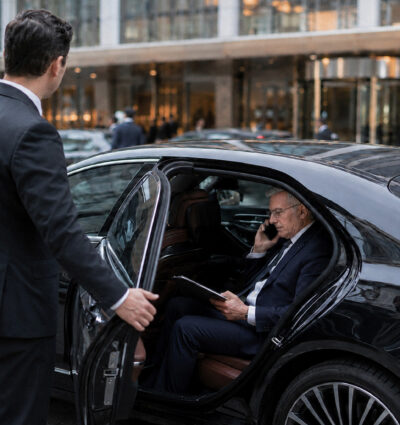
Rather than following a simple hotel-conference-hotel routine, executives move continuously between locations serving different purposes. Ground transportation becomes one of the elements holding the entire business trip together.
The journey from the airport often provides the first opportunity to prepare for a board meeting after an overnight flight. The drive between two appointments may be the only moment available to review confidential documents, exchange views with colleagues, or simply regain focus before the next meeting begins. Later in the evening, the transfer back to the hotel may become the first opportunity all day to return calls from teams working in another time zone.
Beyond transportation: protecting business continuity
Viewed individually, every transfer appears straightforward. During finance conference season, however, every journey sits between two meetings that have often taken weeks or months to arrange.
A delayed airport pickup may reduce the time available to prepare for the day’s first client meeting. An unexpected change of venue can affect every appointment that follows, while a dinner that finishes later than planned may require immediate adjustments to the following morning’s schedule. In that environment, transportation helps preserve the flow of an itinerary where each conversation depends, at least in part, on the previous one unfolding as planned.
This is why executive ground transportation should not be evaluated as a standalone booking. Flight monitoring, chauffeur vetting, the ability to react quickly to schedule changes, consistent service standards across different destinations, and clear communication throughout the journey all contribute to protecting what executives value most during these weeks: their time.
Comparing providers exclusively on availability or price may be sufficient for occasional transfers, but it offers only a partial view when senior executives are attending several high-profile events over a short period of time. In those circumstances, consistency, responsiveness, and visibility become just as valuable as cost.
The conversations behind the headlines
The world’s leading finance conferences are remembered for keynote speeches, market announcements, and product launches. Those moments shape the industry’s public conversation, but they represent only a small part of what actually takes place during these exceptionally busy weeks.
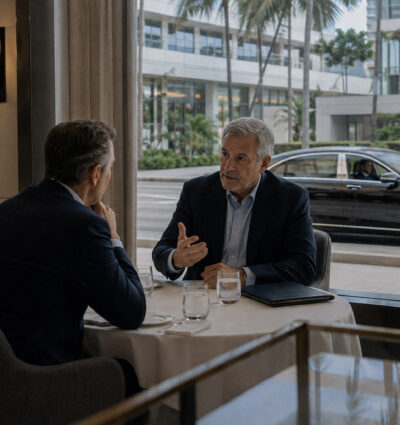
Many of the discussions that ultimately influence business decisions take place somewhere else: over breakfast before the conference begins, during the drive between two meetings, across a lunch table with a long-standing client, or over dinner after the exhibition halls have closed. The conference brings these people together, but it is rarely where the discussions that matter most begin or end.
By the time the autumn conference season comes to an end, the headlines will naturally focus on what happened on stage. Yet behind many of those announcements will have been dozens of conversations that never appeared on the official program, taking place across hotel lobbies, restaurants, meeting rooms, and journeys between them. Those conversations rarely attract attention, but they are often where relationships are strengthened, opportunities are created, and business decisions begin to take shape.