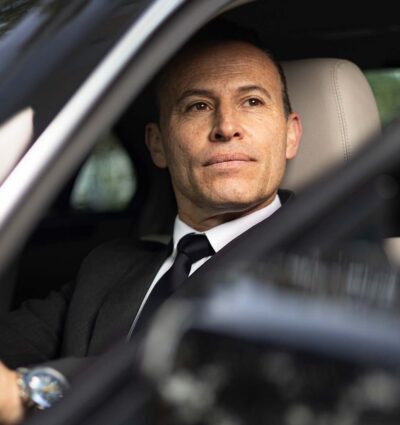
Anyone with a driver’s license can take a person from point A to point B. However, when it comes to executive travel and high-profile passengers, far more is required than simply knowing how to drive. For travel organizers, this is an operational and duty-of-care responsibility on top of a service decision.
Let us consider a real-life scenario. A high-profile passenger enters the vehicle, settles in, and opens their laptop. The ride unfolds smoothly, and they arrive on time without effort or friction. An experience like this does not happen by chance. Behind it is a chauffeur who anticipates traffic, knows alternative routes, drives smoothly, reads the passenger’s tone, and adjusts their level of interaction accordingly. From a corporate travel perspective, this “no-friction” outcome is the result of controls: preparation, operational judgment, and consistent execution.
Below, we outline the criteria that define a high-standard chauffeur and the controls used to verify them before and after every service.
Professional presence: the first filter
It takes just five seconds of interaction for a passenger to form an opinion about a chauffeur. Professional presence is the calling card that defines the perception of the service from the very first moment. For corporate travel programs, it also sets the baseline for professionalism and trust.
While good presence may seem abstract or subjective, in reality it is shaped by a set of concrete factors that cannot be left to chance. Impeccable attire, proper posture, appropriate body language, and flawless personal hygiene are some core elements every chauffeur must meet.
For travelers, the journey begins before entering the vehicle. A courteous welcome, confident handling of luggage, and a presence aligned with the occasion set the tone from the outset. When this first filter fails, trust erodes quickly, and the service is compromised before the transfer even begins.
That said, professional presence is only the first layer. Operational capability is what protects service continuity when conditions change. Below, we examine what this means in practice and how it impacts the delivery of your next booking.
Operational skills: the foundation of an excellent service
Operational skills are what truly separate a premium chauffeur from an average one. Presence and courtesy matter, but if communication fails or driving quality introduces risk, the service fails at its core.

Let us start with a fundamental requirement: English proficiency, in addition to the local language. The goal is not conversation but operational fluency. English enables the chauffeur to confirm changes, answer timing questions, and coordinate efficiently when unexpected situations arise. A passenger should never be required to translate, repeat instructions, or manage operational communication. That responsibility belongs to the chauffeur.
Driving quality is the other critical pillar. Premium driving is not defined by speed but by the absence of abruptness. The passenger should not feel harsh braking, aggressive acceleration, or sharp lane changes. Comfort and safety take priority at all times. A chauffeur who accelerates to “recover time” is not demonstrating skill but poor anticipation and planning.
Approachability and discretion: the foundations of personal interaction
A premium chauffeur is courteous and professional but also discreet and capable of knowing when to speak and when to remain silent. Some passengers enjoy conversation, asking about the city, local insights, or recommendations, or simply engaging in light dialogue during the ride. Others use the time to work, take important calls, manage emails, or simply enjoy silence and rest.
Excellence lies not in extroversion, but in correctly reading the passenger, adapting to their tone, and respecting their space. This is also a matter of confidentiality and professional conduct—especially in executive and corporate environments. This level of mastery goes beyond manuals and is refined through experience and continuous feedback.
Local knowledge: far more than using a GPS
Any GPS can provide directions. A chauffeur with local knowledge can anticipate traffic patterns, propose alternatives, and identify areas affected by events, closures, or peak congestion.
Experienced chauffeurs understand, for example, which streets consistently slow down after office hours or how major venues impact traffic flow. This insight is built over time and becomes a tangible advantage for time-sensitive journeys.
Drivania’s approach is to apply consistent standards across destinations while leveraging local expertise, so service conditions remain predictable and controllable at scale.
Flexibility and proactivity: adapting when circumstances change
High-profile journeys are carefully planned but rarely executed exactly as designed. Last-minute changes are common, and this is where flexibility and proactivity become decisive.
A top-tier chauffeur applies judgment and operational awareness when adjustments are required in real time. Being reactive means waiting for instructions or remaining static in complex situations. In contrast, being proactive implies anticipating the issue, adapting early, and resolving it before it impacts the passenger.
For corporate travel teams, this capability reduces operational disruption and limits the need for manual intervention.
It is not just about driving the vehicle but managing it
A chauffeur is not only a driver but also the custodian of the vehicle. This includes full command of climate control, seating configurations, screens, audio systems, and onboard comfort features.
At a higher level, top-tier chauffeurs also demonstrate mechanical awareness, allowing them to detect issues before they affect the service. Identifying the source of an unusual sound, for example, can prevent delays, discomfort, or service disruption.
For this reason, Drivania evaluates not only the chauffeur’s skills but also the vehicle’s condition and the chauffeur’s technical understanding of it.
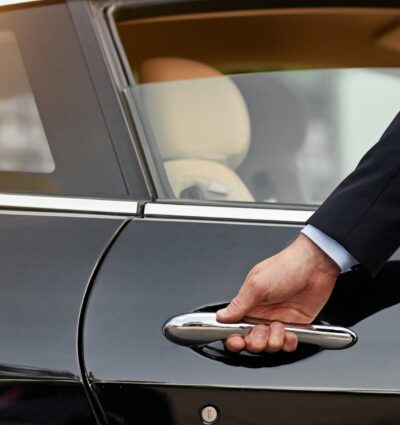
Chauffeurs for private aviation and high-profile passengers
A specialised subset of chauffeurs is trained specifically for private aviation and high-profile travel, where timing, access, and coordination requirements are significantly more complex than in commercial environments.
These professionals are accustomed to operating across executive terminals and working directly with FBO teams, following strict access procedures and coordinating airside pickups when authorised. Because protocols vary by location, they are also familiar with terminal-specific rules, security requirements, and on-site coordination processes.
To meet these operational demands, they undergo advanced road safety training, including evasive driving and passenger protection procedures. This level of capability is not standard across the industry and typically requires extensive experience, ongoing evaluation, and continuous advanced training.
In business aviation, ground transportation is not simply the final leg of the journey—it is a time-critical operational component. With each terminal applying its own regulations and access controls, specialised chauffeurs become essential to ensuring secure, efficient, and predictable execution.
How Drivania selects and evaluates its chauffeurs
At Drivania, we maintain strict procedures for chauffeur selection and vetting, supported by continuous training to ensure consistent operational excellence across our global network.
Our selection criteria include, among other:
- Verification of prior experience
- Language evaluation
- Driving assessment
- Technical knowledge assessment
Candidates who meet these requirements must then pass Drivania’s internal certification process before joining our professional chauffeur network, serving clients in over 350 destinations worldwide.
Once approved, performance is continuously monitored through passenger feedback, operational reports, and vehicle audits. Because certainty is sustained not only through rigorous initial selection but also through ongoing evaluation and continuous training.